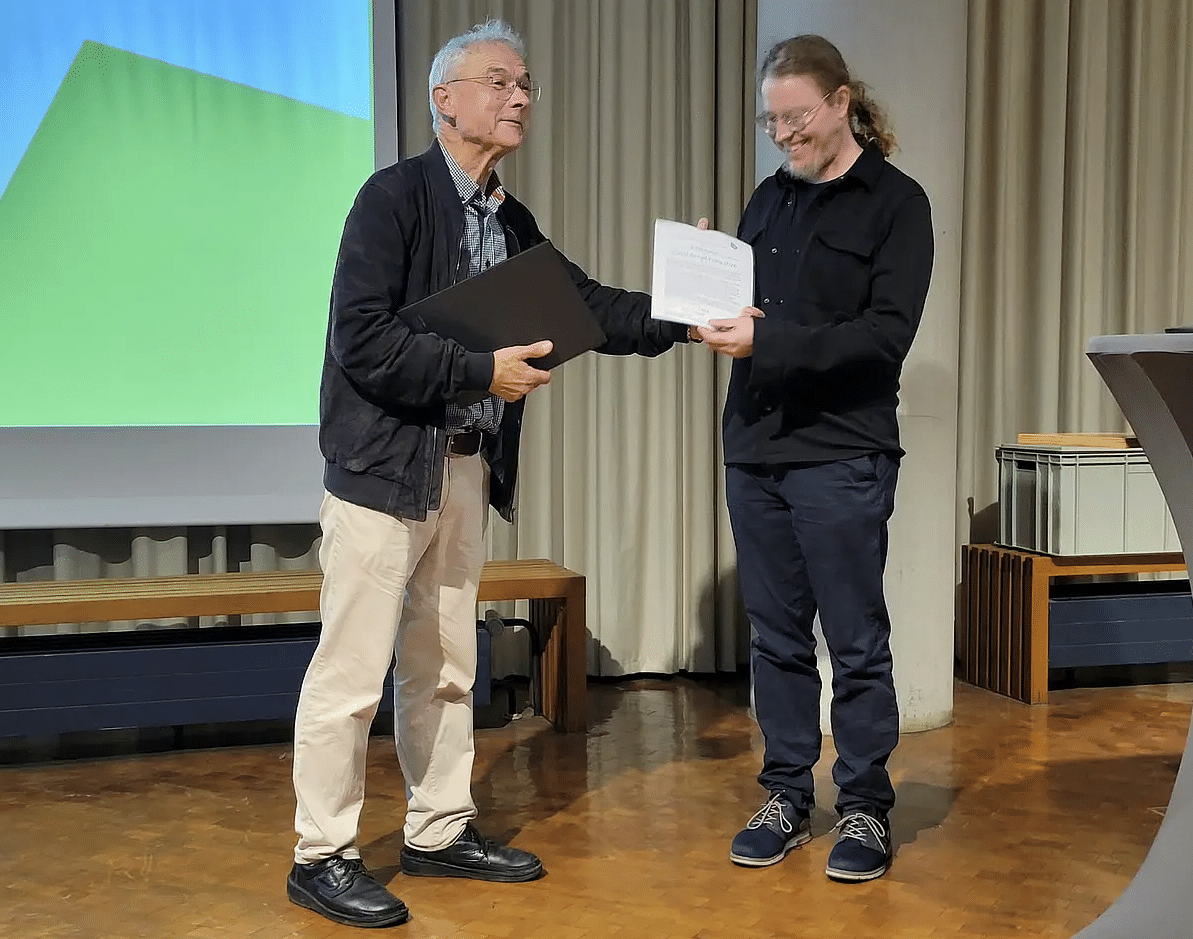
GACT-member Chris Baumann has been awarded the 2026 Science Prize of the Society for Natural History in Württemberg.
The prize, presented on 1 October 2026, recognizes Baumann’s research into how human-induced changes to landscapes affect European wildcat populations. His award-winning study investigates how wildcats, domestic cats and their hybrids differ in their use of food resources and what these differences can tell us about the ecological pressures faced by wildcat populations in human-dominated landscapes.
For his study, published earlier this year in PLOS ONE, Baumann used stable isotope analysis of cat hair to reconstruct the animals’ diets. He compared a largely pure wildcat population living in continuous forest in the Taunus with a younger population in the Markgräflerland, where wildcats inhabit a more open landscape and hybridisation with domestic cats is more common. He also analysed archived material from Thuringia spanning up to 26 years, allowing him to investigate how wildcat diets changed as forests increasingly gave way to agricultural landscapes.
The results revealed clear differences in the dietary niches of wildcats, domestic cats and hybrids. Hybrids showed the broadest dietary range, potentially increasing competition for food resources with wildcats. At the same time, the long-term data from Thuringia indicate that wildcats can adapt their diets to changing landscapes and make use of prey from open habitats.
The study provides new insights into how wildlife populations respond to human-driven environmental change. It also highlights the potential of stable isotope analysis as a non-invasive tool for wildlife monitoring and conservation.
Baumann receives the prize for what the Society for Natural History in Württemberg describes as a “conceptually innovative approach” to addressing a key conservation question: to what extent are European wildcats affected by hybridisation with domestic cats and by competition for food resources?
The award, endowed with €1,500, was established in 1985 in honour of geologist Walter Schall and recognizes outstanding scientific work in the field of natural history.